Abréviation, date d’édition et statut des principaux textes et documents utilisés
Pages 11 to 11
[Épigraphe]
Pages 19 to 45
Introduction
Pages 47 to 102
Préambule : Le fragment de « Joachim Fest »
Pages 103 to 108
Première partie : Crise collective et biographie de l'écrivain
Pages 109 to 178
Chapitre I : La décennie 1929-1939, une « époque carrefour »
Pages 179 to 317
Chapitre II : Une formation entre deux guerres
Pages 319 to 351
Chapitre III : 1914-1918. Une « scène primitive », la « première guerre »
Pages 353 to 356
Deuxième partie : Un éclairage sur la naissance de Julien Gracq (1937-1939)
Pages 357 to 402
Chapitre IV : Au Château d'Argol. Publication, réception
Pages 403 to 442
Chapitre V : « Crise intra-subjective » et « malaise dans la civilisation »
Pages 443 to 501
Chapitre VI : Médiations
Pages 503 to 511
Troisième partie : Une poïétique à fleur de texte. La suture fiction-guerre
Pages 513 to 555
Chapitre VII : Une poïétique de la « dépense vitale »
Pages 557 to 618
Chapitre VIII : Affect historique et écriture. Une « influence qui crève les yeux »
Pages 619 to 678
Chapitre IX : Un amalgame producteur de sens
Pages 679 to 701
Conclusion
Pages 703 to 737
Bibliographie
Pages 739 to 745
Annexes
Pages 747 to 757
Index
Pages 759 to 765
Table des matières
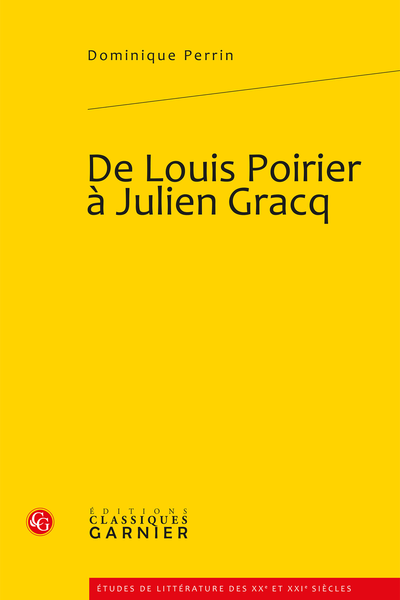
Born in 1910, Louis Poirier became Julien Gracq in 1938. From his arrival in Paris in 1929 through the “Phoney War,” a period of intense turmoil and unrest in Europe coincided with the writer’s intellectual formation, social emergence, and self-invention. Placing his literary debut in its historical context and considering the diversity of available sources allows us to question the label of Julien Gracq as a “timeless” and “unplaceable” classic. What emerges most clearly are three intertwined enigmas. A biographical one: Louis Poirier, a geomorphologist and Communist Party militant, became, at twenty-seven, an immediately paradoxical author with the publication of Au château d’Argol. An epistemological one: Writing, for him, is rooted in an almost libidinal affective economy. Finally, a poetic enigma, as focusing on the Poirier-Gracq figure leads us back to a fundamental question about the texts themselves: How can we understand the configuration of meaning in a fictional work that generates such complex affective responses?
CLIL theme: 4027 -- SCIENCES HUMAINES ET SOCIALES, LETTRES -- Lettres et Sciences du langage -- Lettres -- Etudes littéraires générales et thématiques